
The Longitudinal Menopause Project
This is your chance to be a part of science! 🧬

At the recent qb3 Ovarian Health Symposium, Dr. Emily Jacobs, a world-leading voice in studying the female brain across the lifespan (and a researcher AthenaBIO and Research Hub proudly supported to publish a pre-print), spoke of The Longitudinal Menopause Project, the data collection initiative we felt an imperative to share.
For context, one of the biggest bottlenecks in women’s health is data. Some of the most valuable work that could be done at the moment to advance women’s health R&D is building robust data sets, beyond digital biomarkers.
If you know women in California who could be eligible, please share this. If you or your organization are ever working on these types of projects, please do share with us. We want to support any data-collection initiatives to advance sex-specific research and science.
Do you live in California?
Are you a woman between the ages of 40-55?
Living in San Francisco, Santa Barbara, or San Diego?
This is your chance to be part of a groundbreaking study for menopause.
Background
Nearly two-thirds of Americans living with Alzheimer's disease are women, a disparity too large for longevity alone to explain. Increasingly, researchers are looking to a different inflection point: the menopausal transition. Ovarian estradiol production declines by up to 90%, resulting in an endocrine shift with consequences that reach far beyond reproduction and into cognitive decline.
Neuroimaging studies are revealing what this shift looks like in real time, with changes in brain structure, energy metabolism, and the early markers of neurodegenerative pathology emerging during this window. Put simply, menopause is emerging as an incredibly consequential yet poorly understood chapter in the story of female brain aging.
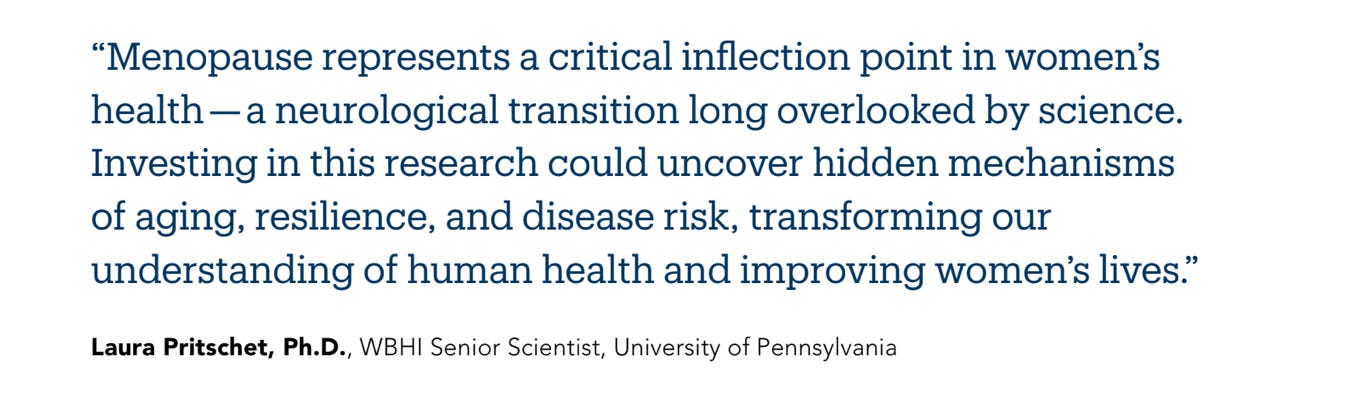
Yet for all we are starting to see, we remain limited by what we have not measured. The promise of data-driven discovery risks repeating the failures of every era before it if the datasets powering this new age are not intentionally built with women in mind. This is why work like the Longitudinal Menopause Project is now more critical than ever.
Make your data count.

The mission of the Longitudinal Menopause Project Roadmap:
Establish a flagship study of the menopause transition and its implications for brain health in the United States that will result in high-impact innovation for the scientific field for decades to come.
Develop fast-track translation of experimental and medical findings to directly impact the community.
Create a shared, open-science resource for the global scientific community to accelerate the pace of discovery.
Translate findings into policy that ensures high-quality, evidence-based care for women.
The project, now in its planning phase, will follow women extensively across the menopausal transition, pairing brain, biofluid, cognitive, and health data.
If you would like to help research, please join their participant registry, or share with women who could be part of this!
Meet Rejoovenate Bio
Building a solution to improve IVF outcomes.

Join us for an online webinar to meet Iris Lam, the founder of Rejoovenate Bio, and founding scientist Dr. Manju Sharma, a stem-cell biologist.
Learn about restoring and improving oocyte quality in IVF.
📆 Date: Thursday, May 14th, 2026
⏰ Time: 12:00 PM ET
📍 Location: Online
Rejoovenate Bio is a fertility biotech company focused on addressing age-related declines in egg quality. Rejoovenate is developing laboratory-based solutions designed to improve reproductive outcomes by targeting the underlying biology of reproductive aging without systemic exposure. Their approach is built to integrate seamlessly into existing IVF workflows, enabling fertility clinics to offer more effective options for patients of advanced maternal age.